Pickleball rules for beginners: serve, kitchen and scoring
The court, the serve, the two-bounce rule, the dreaded kitchen, and how to call a score like '4-2-1'.
Pickleball is a paddle sport that mixes pieces of tennis, badminton and table tennis on a court small enough that beginners can rally within minutes. It is played with solid paddles and a light plastic ball with holes. Most rec play is doubles, and most of the confusion for new players comes from three things: the serve, the two-bounce rule and the kitchen. This guide covers the core rules as written in the official rulebook, which is updated every year, so always check the current version or your club's rules for fine print.
The court and the kitchen
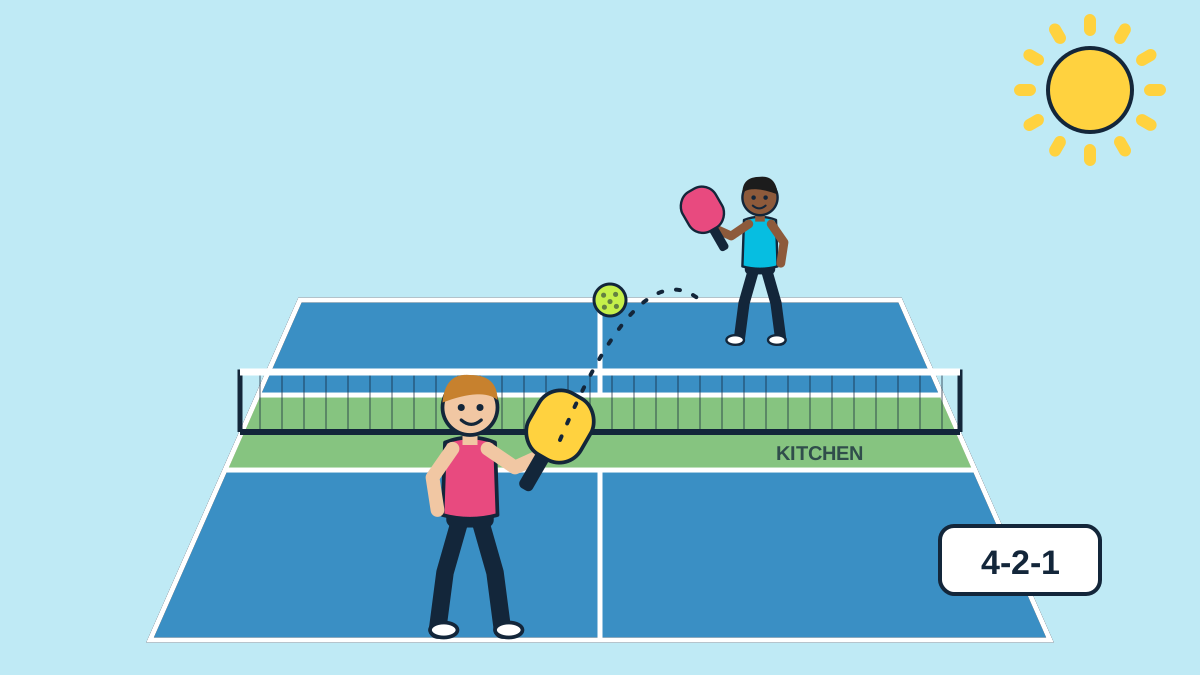
A pickleball court is 20 feet wide and 44 feet long, the same size as a doubles badminton court. The net is 36 inches high at the sidelines and dips to 34 inches in the middle. On each side of the net, a zone stretches 7 feet back. Officially it is the non-volley zone, but everybody calls it the kitchen.
Behind the kitchen, each half of the court is split down the middle into a right and left service court. Players serve from behind the baseline into the service court diagonally opposite.
Serving
The serve starts every rally, and it has more rules than any other shot:
- Serve from behind the baseline, with at least one foot on the ground behind it and neither foot touching the baseline or court at contact.
- Serve diagonally, to the service court opposite.
- For a standard volley serve, the motion is underhand: your arm moves in an upward arc, the paddle contacts the ball below your waist, and the paddle head is below your wrist at contact.
- A drop serve, where you drop the ball and hit it after it bounces, is also allowed and has fewer motion restrictions.
- The serve must clear the kitchen and land in the correct service court. A serve landing on the kitchen line is short, which is a fault. Landing on the sideline, centre line or baseline is in.
- You get one serve attempt, not two as in tennis.
The first server on each side starts from the right-hand court. After each point the serving team wins, the server switches sides with their partner and serves again from the other court.
The two-bounce rule
After the serve, the ball must bounce once on the receiving side before it is returned, and then bounce once on the serving side before it is hit again. Only after those two bounces can players volley. This rule stops the serving team from rushing the net and smashing the return, and it is the reason good players often use a soft "third shot drop" into the opponent's kitchen.
The kitchen rule
You may not volley while standing in the kitchen or touching the kitchen line. That includes your follow-through and momentum: if you volley from just outside the line and then step or fall into the kitchen, it is still a fault, even if the ball is already dead. You may enter the kitchen at any other time, for example to play a ball that has bounced there, and you can stay in as long as you like. Just get back out before you volley.
Faults and how scoring works
A fault ends the rally. Common faults are hitting the ball out of bounds, hitting into the net, volleying before the two bounces are done, volleying from the kitchen, and serve errors.
In traditional scoring, only the serving team can win points. Games are usually played to 11 and must be won by 2. In doubles, both players on a team serve before the serve passes over (a "side out"), except at the very start of the game, when the first team gets only one server.
That is why doubles scores are called as three numbers: the serving team's score, the receiving team's score, and whether the server is server 1 or server 2. The game begins at "0-0-2".
| Score called | What it means |
|---|---|
| 0-0-2 | Start of game. The first serving team has one serve turn only. |
| 4-2-1 | Serving team has 4, receiving team has 2, and the first partner is serving. |
| 4-2-2 | Same score, but the first server has lost a rally, so the partner now serves. |
| Side out | Both servers have lost a rally; the other team starts serving. |
Some leagues and events use rally scoring, where every rally wins a point regardless of who served. If you join a club or ladder, ask which format it uses.
Etiquette that makes you a welcome partner
Call the score loudly before every serve. Call balls on your side honestly, and if you are not sure, it is in. Tap paddles at the net after a game. When you join open play, put your paddle in the rotation queue rather than jumping onto a court. And if you are new, say so: most pickleball regulars remember their first week and will happily explain the kitchen for the hundredth time.
FAQ
Can you step in the kitchen in pickleball?
Yes, you can stand in the kitchen at any time. What you cannot do is volley (hit the ball out of the air) while touching the kitchen or its line, or let your momentum carry you into it after a volley.
Why does the score start at 0-0-2?
In traditional doubles scoring, the first serving team of the game gets only one server before the serve passes to the other team. Calling the server as '2' at the start signals that only one serve turn is left.
Is the kitchen line in or out?
The kitchen line is part of the kitchen. A serve that lands on the kitchen line is a fault. On other shots during a rally, a ball landing on any line except the kitchen line on a serve is in.
What is rally scoring in pickleball?
Rally scoring gives a point on every rally, no matter who served. It has been used in some formats and tested in some events, but traditional side-out scoring is still what most recreational games use. Check your league or club.