How bowling scoring works (and what a league handicap is)
Strikes, spares, the tenth frame and league handicaps, with a worked example you can follow along with.
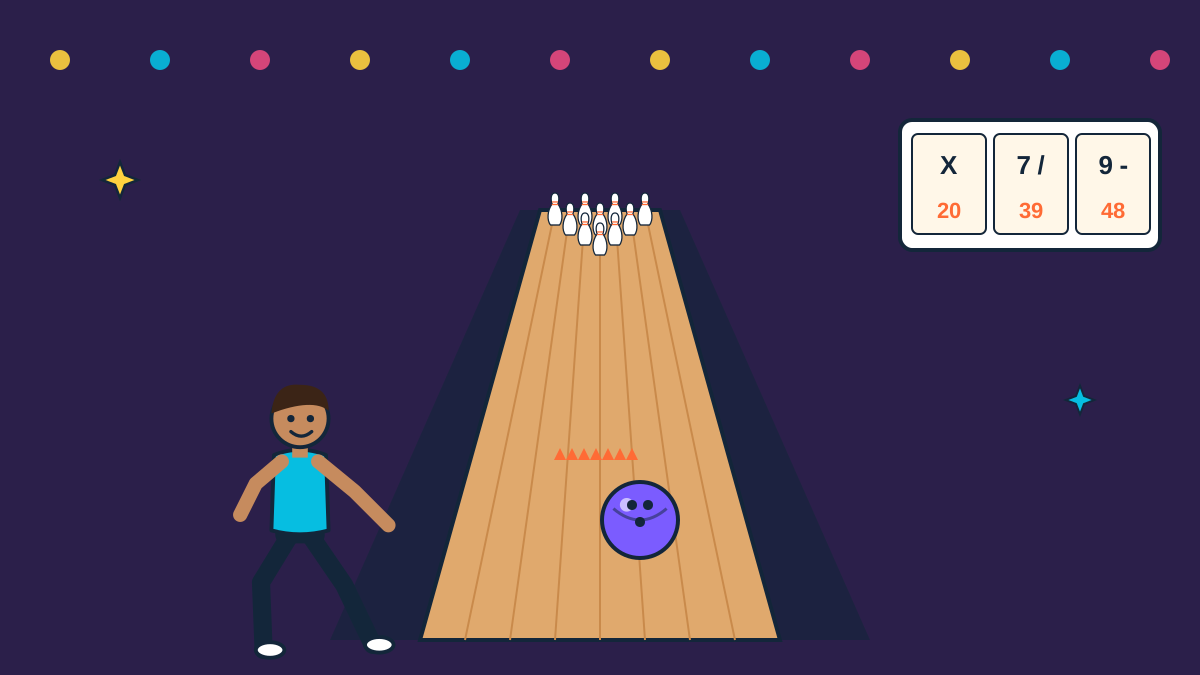
Bowling is one of the easiest social sports to join: the venue supplies the lanes, the balls and the shoes, and the automatic scoring does the maths. But if you want to understand why a strike is worth so much more than nine pins, or what the league secretary means by "handicap", it helps to know how the scoring actually works. Once it clicks, you will find yourself calculating your score before the screen does.
The basics: ten frames, ten pins
A game of ten-pin bowling has ten frames. In each frame you get up to two balls to knock down ten pins. If you knock them all down with your first ball, the frame ends immediately. The tenth frame is special and can include a third ball, which we will cover below.
If you do not knock down all ten pins across your two balls, your score for that frame is simply the number of pins you knocked down. That is called an open frame. The fun begins when you knock them all down.
Strikes and spares
- Strike (X): all ten pins down with the first ball of a frame. You score 10 plus the pins you knock down with your next two balls.
- Spare (/): all ten pins down using both balls of a frame. You score 10 plus the pins you knock down with your next ball.
Those bonus balls are why strikes and spares are so valuable. A strike followed by another strike followed by another strike gives the first frame 30 points. String twelve strikes together across a game and you score the maximum, 300.
Because a frame's score can depend on balls you have not rolled yet, the running total for a strike or spare frame stays blank until the bonus balls are known. That is why the scoreboard sometimes seems to be a frame or two behind.
A worked example
Here is how the first six frames of a made-up game add up. Follow the running total column to see how the bonuses land.
| Frame | Balls | How it is scored | Running total |
|---|---|---|---|
| 1 | X | 10 + next two balls (7 + 3) = 20 | 20 |
| 2 | 7 / | 10 + next ball (9) = 19 | 39 |
| 3 | 9 – | Open frame: 9 + 0 = 9 | 48 |
| 4 | X | 10 + next two balls (10 + 8) = 28 | 76 |
| 5 | X | 10 + next two balls (8 + 1) = 19 | 95 |
| 6 | 8 1 | Open frame: 8 + 1 = 9 | 104 |
Notice how frame 4's strike earned bonus pins from both frame 5 (a strike, 10) and the first ball of frame 6 (8). Frame 3's nine pins were followed by a miss, shown as a dash.
The tenth frame
The last frame gives you the chance to collect the bonus balls you would otherwise miss out on:
- If you roll a strike with your first ball, you get two more balls.
- If you roll a spare with your first two balls, you get one more ball.
- If you leave pins standing after two balls, your game is over.
So the tenth frame can be up to three balls, and the most it can score is 30 (three strikes).
Reading the score sheet
Bowling has its own shorthand. Here are the symbols you will see on most screens and paper sheets:
Score sheet symbols
- X: strike
- /: spare
- –: a ball that knocked down no pins
- F: foul (you crossed the foul line); the ball counts as zero pins
- Circled number: a split was left
- G (on some systems): a gutter ball
What a league handicap is
Most social and many competitive bowling leagues use handicaps so bowlers of different skill can compete on even terms. The idea is simple: bowlers with lower averages get bonus pins added to each game.
Leagues set their own formula, but a common approach is to take a percentage of the difference between a basis score and your average. For example, a league might use 90 percent of the difference between 220 and your average. A bowler averaging 150 would get 90 percent of 70, which is 63 pins added per game. A bowler averaging 200 would get 18. Teams usually add up their bowlers' handicaps too.
New bowlers without an established average often bowl a few games before a handicap is set, or are given a starting average by the league. Ask your league secretary how they handle it, and remember that a handicap is not charity: it is the reason a brand-new team can win the whole season.
Etiquette on league night
Bowling has a few unwritten rules that make the night run smoothly. The bowler on your right usually goes first if you are both ready at the same time. Stay behind the foul line. Do not use someone else's ball without asking. Keep drinks and food off the approach, because wet or sticky shoes can cause slips. And when a teammate throws a strike, a high five is compulsory.
FAQ
What is a perfect game in bowling?
A perfect game is 300: twelve strikes in a row, one in each of the first nine frames and three in the tenth.
What does a dash mean on a bowling score sheet?
A dash marks a ball that knocked down no pins. It is sometimes called a miss or, when it happens on the second ball of a frame, an open frame.
What is a split?
A split is a leave where the headpin is down and the remaining pins are separated by a gap, such as the 7 and 10. Splits are hard to convert into spares, so they are often marked with a circle on the score sheet.
Do I need my own ball to join a league?
No. Most bowling centres have house balls and rental shoes. Many league bowlers eventually buy a ball drilled to fit their hand, but it is not needed to start.