Cornhole rules and scoring, explained simply
Board setup, how cancellation scoring works, fouls, and the house rules that change from bar to bar.
Cornhole looks like the simplest game at the barbecue, and in many ways it is: you throw small bags at a slanted board with a hole in it. But league nights run on a specific set of rules, and the scoring system confuses almost everyone the first time. Here is how the game works, based on the rules used by the major cornhole organisations and most bar leagues, plus the variations you are likely to meet.
The setup: boards, bags and distance
A regulation cornhole board is a rectangle 2 feet wide and 4 feet long with a 6-inch hole. The hole is centred 9 inches from the top edge. The back of the board sits 12 inches off the ground and the front edge sits a few inches up, which creates the slope. Bags are about 6 inches square, filled with resin pellets or corn, and weigh roughly a pound.
The two boards face each other with their front edges 27 feet apart. Casual and junior games often shorten this, and many bars simply use whatever space fits. Each side of a board has a "pitcher's box", the area beside the board where the thrower must stand. The front edge of the board extended sideways is the foul line.
| Item | Common regulation spec |
|---|---|
| Board size | 24 in × 48 in playing surface |
| Hole | 6 in diameter, centred 9 in from the top |
| Board height | 12 in at the back, roughly 2.5 to 4 in at the front |
| Distance | 27 ft between the front edges of the boards |
| Bags | About 6 in × 6 in, around 1 lb each, 4 per player |
How a game flows
Cornhole can be played as singles (one against one) or doubles (two against two). In singles, both players stand at the same board and throw at the opposite one, then walk down, score, and throw back. In doubles, one player from each team stands at each end, so partners face each other and nobody has to walk.
Each player has four bags of their team's colour. Players alternate throws, one bag at a time, until all eight bags have been thrown. That set of eight throws is called an inning (some people say frame or round). Then the bags are scored and the next inning begins from the other end.
Who throws first? Usually a coin toss decides the first inning. After that, the team that scored in the previous inning throws first. If nobody scored, the team that threw first last time goes first again.
Scoring: cancellation is the whole trick
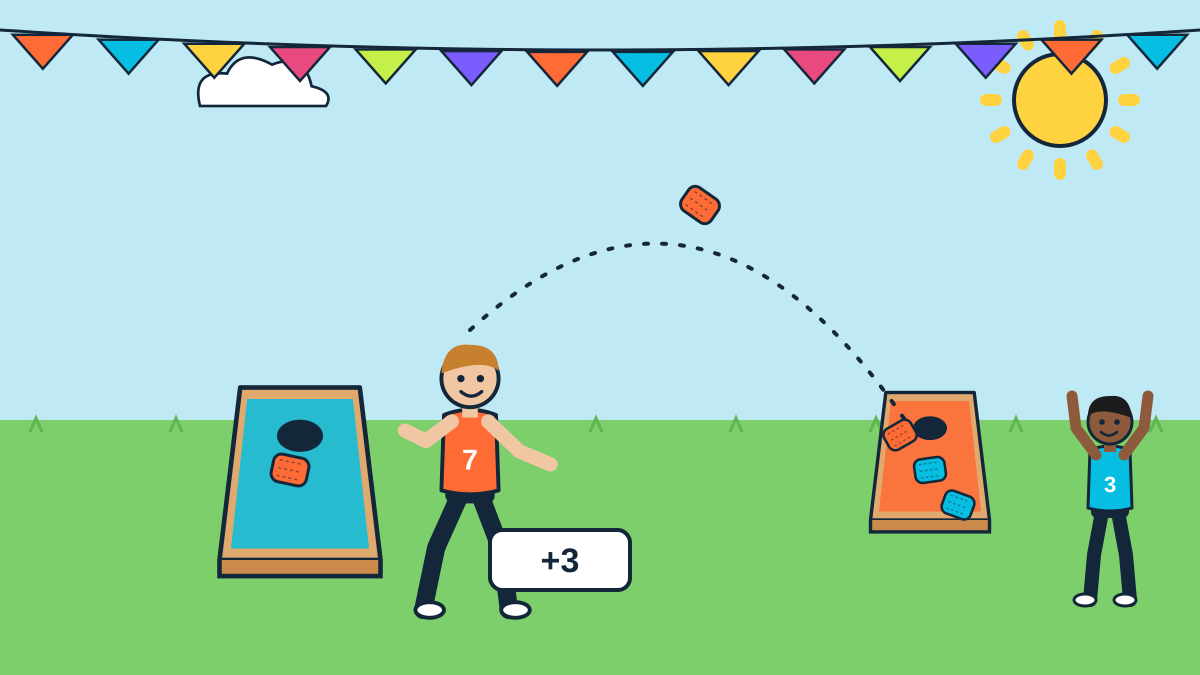
A bag that ends up in the hole is worth 3 points. A bag that ends up resting on the board surface is worth 1 point. A bag that touches the ground at any point, even if it bounces back onto the board, is dead and scores nothing. It should be removed before the next throw.
Here is the part that trips people up: points cancel. After an inning, you add up each team's points and only the difference goes on the scoreboard. So if your team puts one bag in the hole and one on the board (4 points) and the other team puts two on the board (2 points), your team scores 2 and the other team scores 0.
Worked example
- Team Orange: 1 bag in the hole (3) + 2 on the board (2) = 5
- Team Blue: 2 bags in the hole (6) = 6
- Difference: Blue scores 1 point this inning. Orange scores 0.
The first team to reach or pass 21 points at the end of an inning wins. Because of cancellation, a single inning where one team throws four bags in the hole and the other scores nothing is worth 12 points. That is called a "four-bagger" and it is the best feeling in the sport.
Fouls and what they cost you
A foul means the thrown bag is removed and scores nothing, and in some rulebooks any bags it moved are put back. Common fouls include:
- Stepping past the foul line (the front of the board) before releasing the bag.
- Throwing from outside the pitcher's box.
- Taking longer than the allowed time to throw, if your league uses a time limit.
- Throwing from the wrong box after sides are set.
- A bag that hits the ground, a person or an object before landing on the board. That bag is dead.
House rules you will meet
Cornhole's popularity at parties means there are many local variations. None of these are wrong, but they change strategy, so settle them before the first throw.
- Bust rule. Going over 21 drops your score back to a set number, often 11 or 15. Official league play does not use this.
- Shorter games. Some bar leagues play to 11 or 15, or use a time limit, to keep the night moving.
- Skunk rule. A game ends early if one team leads by a big margin, for example 11 to 0.
- Rotating partners. "Blind draw" nights pair you with a random partner each round, which is a great way to meet people.
Beginner tips for league night
Hold the bag flat, swing your arm like a pendulum, and aim to land the bag a foot or so short of the hole so it slides up. A flat, spinning bag lands softly and is less likely to bounce off. Pick one spot in the pitcher's box and stand there every time, since consistency matters far more than power. And when the board gets crowded, a bag that pushes an opponent's bag off the board is worth as much as one that scores.
FAQ
Do you have to hit exactly 21 in cornhole?
Not under the main league rulebooks: the first team to reach or pass 21 at the end of an inning wins. Some backyard players use a 'bust' rule that sends you back if you go over 21, so check before you start.
Does a bag hanging over the hole count as 3?
No. A bag only scores 3 once it falls through the hole. If it is hanging on the lip and resting on the board surface, it counts as 1 point, as long as it is not also touching the ground.
Can you knock your own bag into the hole?
Yes. If a later bag pushes a bag already on the board into the hole, the bag that fell in scores 3 for its owner, whichever team threw the bag that knocked it.
What is an airmail?
An airmail is a throw that goes straight into the hole without touching the board surface first. It scores 3 like any other bag in the hole.